

With the rapid growth of the global pet care market, cat litter manufacturing has become an attractive business for both startups and established producers. Understanding common cat litter raw materials and basic cat litter production equipment is the first step toward building a cost-effective cat litter production line.
This article introduces widely used materials for cat litter and explains how simple machinery can turn them into market-ready products.
Popular Raw Materials for Cat Litter Manufacturing
Different markets prefer different types of cat litter, and raw material selection directly affects product performance, cost, and positioning.
Bentonite clay is one of the most widely used materials in traditional cat litter production. It offers strong clumping ability and good moisture absorption, making it popular in mass markets.
Tofu cat litter raw materials, such as soybean fiber, corn starch, and pea fiber, are increasingly favored for eco-friendly and biodegradable products. These plant-based materials are lightweight, flushable, and low in dust.
Silica gel is another option, known for high absorbency and odor control, though it requires more complex processing and higher investment.
In addition, recycled materials like paper pulp, wood fiber, and sawdust are often used to produce natural or low-cost cat litter products.
Simple Cat Litter Production Equipment Explained
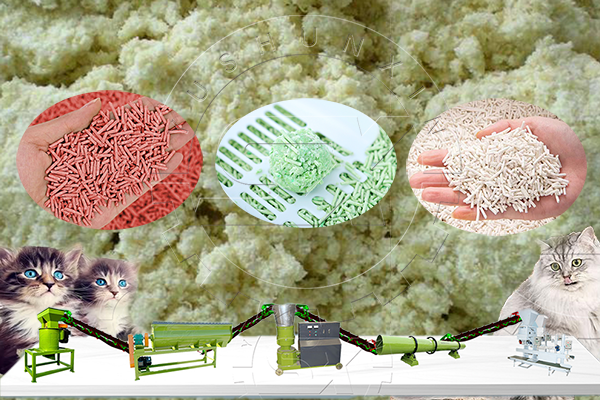
For small-scale or startup investors, a simple cat litter manufacturing line can be designed with modular equipment.
The process usually starts with a crusher or grinder to reduce raw materials into uniform particles. A mixer then blends the materials with binders or additives to improve shaping and performance.
Next, a cat litter granulation machine—such as an extrusion granulator or disc pelletizer—forms the litter into pellets or granules. After shaping, a dryer reduces moisture to improve product stability, followed by a screening machine to separate qualified particles.
For low-budget projects, semi-automatic packaging machines are commonly used. Learn more!
Matching Raw Materials with the Right Equipment
Different raw materials require different processing methods. For example, bentonite cat litter production equipment focuses on granulation and drying, while tofu cat litter manufacturing lines emphasize extrusion shaping and precise moisture control.
Choosing suitable equipment not only improves product quality but also reduces energy consumption and operating costs.
Starting a Cost-Effective Cat Litter Production Line
A low-cost cat litter plant does not mean low quality. By selecting locally available raw materials and simplified equipment, producers can enter the market with controlled investment and scalable capacity.
Many cat litter manufacturers start with basic machines and upgrade their cat litter production line as demand grows. Welcome to consult YUSHUNXIN!
Conclusion
From bentonite clay to plant-based fibers, there are many raw materials suitable for cat litter production. Combined with simple, well-matched machinery, these materials can be transformed into competitive products.
Understanding both materials and equipment is key to building a flexible and profitable cat litter manufacturing operation. If you need a cat litter production business plan, welcome to visit: https://www.fertilizerequipmentprice.com/cat-litter-production-line/