

Lime-based fertilizers play a critical role in soil conditioning and nutrient regulation, yet differences in physical form—granules, pellets, and particles—often determine product performance and production efficiency. In the fertilizer industry, consistent shape and density affect transportation, blending, and nutrient release behavior. Therefore, understanding how lime, limestone, or lime rock powder transforms through various lime granulation methods helps producers improve both quality and cost efficiency. Each form—granule, pellet, or fine particle—requires distinct production technologies and machinery configurations.
1. What Are the Raw Materials Suitable for Lime Fertilizer Production?
Producers can select raw materials such as quicklime, hydrated lime, limestone powder, or even desulfurized gypsum as the main sources for lime-based fertilizer production. Each raw material type influences the granulating procedure differently. For example, limestone powder with fine texture ensures uniform granule formation, while lime rock fragments require more crushing and mixing before granulation.
When industries in metallurgy, environmental protection, or building materials adopt lime fertilizer production, they pursue specific performance benefits. The environmental sector values fine particles for soil neutralization projects because they dissolve quickly. The building-materials sector prefers dense pellets for stable blending with cementitious materials. The agricultural fertilizer industry emphasizes balanced granules for convenient spreading and slow nutrient release. Therefore, raw material selection directly determines the production strategy, machinery configuration, and granule performance.
2. How Do Granules, Pellets, and Particles Differ in Lime Fertilizer Manufacturing?
The distinctions between granules, pellets, and particles lie in both size and formation process. Granules usually come from the granulation procedure involving moderate moisture and compaction; they maintain a uniform diameter and moderate hardness. Pellets, however, result from pelletizing or extrusion that generates denser, larger spheres with higher mechanical strength. Particles, by contrast, represent the fine, ungranulated powders or crushed materials that serve as the raw feed before further shaping.
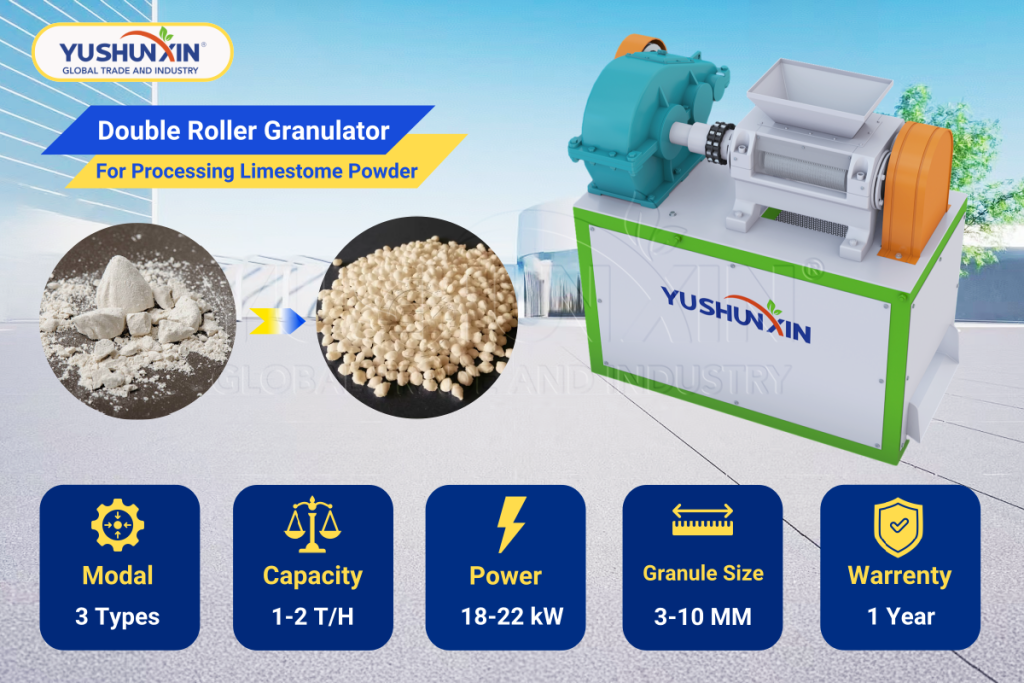
During lime fertilizer manufacturing, producers often adopt different machines for each form. A loader-type feeder manages raw material input, while a chain crusher breaks lime rock into controlled sizes. A horizontal mixer ensures homogeneous blending of limestone powder and additives. For dry compacting, a double roller extrusion granulator or extruder press performs dry granulation without adding excess moisture. After pellet making or ball forming, a rotary screening machine classifies the granules or pellets according to size, and belt conveyors deliver them to an automatic packaging scale for final weighing and bagging. Each equipment piece supports a specific stage in the lime fertilizer production line, ensuring stable capacity and consistent granule quality.
3. What Are the Industrial Advantages of Each Lime Fertilizer Form?
Different industries and application conditions require distinct lime fertilizer forms. In the agricultural field, well-shaped granules dissolve steadily, enhancing nutrient utilization and reducing dust loss. In environmental treatment, compact pellets allow safe transportation and controlled neutralization of acidic wastewater or contaminated soils. In industrial material preparation, fine particles or microgranules provide high reactivity for chemical blending or desulfurization processes.
From a manufacturing viewpoint, dry granulation with double roller extrusion shortens the production process, reduces energy consumption, and minimizes drying steps. Pelletizing or ball making provides a smooth surface that improves product flowability and packaging efficiency. Therefore, producers who understand the technical differences among granule, pellet, and particle manufacturing can adjust machines and process parameters to match specific market demands.
Conclusion
In conclusion, lime fertilizer production involves careful selection of raw materials, appropriate granulation or pelletizing technology, and precise equipment coordination. Each form—granule, pellet, or fine particle—serves a defined purpose across industries, influencing product performance, handling, and profitability. Reliable machinery such as feeders, crushers, mixers, double roller extruders, rotary screeners, and automated packaging systems ensures stable operation and consistent output. A professional fertilizer equipment manufacturer, Yushunxin, provides integrated solutions for lime fertilizer granulation lines, helping producers achieve efficient, high-quality, and sustainable fertilizer manufacturing results. You can visit: https://www.extruder-granulator.com/product/limestone-powder-granulation-machine/