

In lime fertilizer manufacturing, producers need to understand how pelletizing and ball making differ in production procedures, granulation effects, and equipment requirements. These two processes both transform lime-based materials into uniform fertilizer granules, yet each method suits specific raw materials and production goals. By analyzing the composition of lime fertilizers, the operational procedure of granulating systems, and the performance of related machinery, producers can select an optimal solution for lime fertilizer particle preparation.
What Types of Raw Materials Suit Lime Fertilizer Granulation?
Lime-based fertilizers usually derive from limestone, lime rock, hydrated lime, and calcium carbonate powder. Each raw material carries unique properties that influence granule quality. For example, limestone and lime rock provide high calcium content and strong alkalinity, which improve soil structure in industrial land reclamation projects. Hydrated lime powder, due to its fine texture, requires uniform granulation to avoid dusting and ensure stable nutrient release. Calcium carbonate powder suits pelletizing because it forms dense pellets that resist moisture absorption during storage and transportation.
Different industries benefit in different ways. Chemical fertilizer producers emphasize the controlled chemical reactivity of lime-based materials, while environmental treatment companies value the neutralization capacity of lime granules. The steelmaking sector often purchases lime pellets for flue gas desulfurization, where consistent particle size enhances reaction efficiency. Therefore, the choice of raw materials directly determines whether a pelletizing or ball-making production line offers higher efficiency and product uniformity.
How Do Pelletizing and Ball Making Processes Operate Differently?
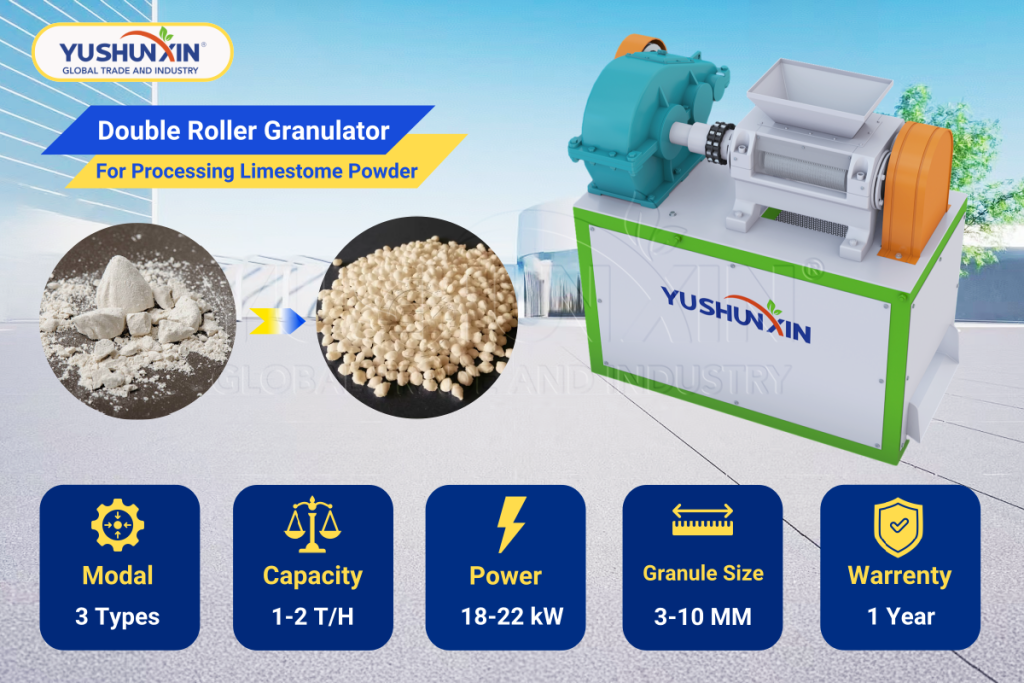
The pelletizing process usually employs a pelletizer or pelletizing disc to roll fine lime powder into compact pellets through continuous rotation and layer buildup. The granulation system needs precise moisture control and binder addition to ensure structural stability. A loader-type feeder transfers raw materials to a clain crusher, which reduces lime rock to smaller particles before entering a horizontal mixer. The mixer blends powders evenly, and then a double roller extrusion granulator shapes them into uniform pellets under mechanical pressure. This dry granulation method minimizes water usage and shortens drying time, which benefits large-scale industrial fertilizer plants seeking high output and low energy cost.
In contrast, the ball making process focuses on the formation of rounder granules through rolling and agglomeration inside a rotating drum or ball-making granulator. The procedure often applies slightly higher moisture content and longer shaping time to achieve spherical particles. This method suits finer hydrated lime powder, where cohesive forces help particles fuse into stable balls. The equipment layout usually includes a belt conveyor connection from the mixer to the ball-making granulator, followed by a rotary screening machine and automatic packaging scale. Compared with pelletizing, ball making yields smoother surfaces but requires more drying and screening operations to control particle size distribution.
What Are the Key Advantages and Equipment Considerations in Each Production Route?
Pelletizing ensures high mechanical strength and uniform density, which simplifies transportation and reduces breakage during handling. The double roller extrusion granulator provides controlled pressure and compact structure for dry granulation, improving production efficiency. Manufacturers prefer pelletizing when the raw lime fertilizer material contains moderate moisture and demands precise shape consistency.
Ball making, however, creates visually appealing and more rounded granules that dissolve gradually in soil. The process offers better adaptability to fine powders and higher moisture formulations. When a factory uses hydrated lime or fine limestone powders, the ball-making line provides smoother granules with less dust emission. The rotary screening machine separates oversized and undersized particles, while belt conveyors ensure continuous movement between sections. Both processes benefit from automated control systems that stabilize output and maintain product uniformity across batches.
How Should Producers Choose Between Pelletizing and Ball Making in Lime Fertilizer Manufacturing?
When selecting the appropriate production process, producers should evaluate raw material characteristics, moisture content, desired particle size, and drying capacity. Pelletizing suits large-scale lime fertilizer manufacturing aiming for compact, durable pellets, while ball making fits flexible operations seeking spherical granules with aesthetic appearance. Each process requires coordinated operation among crushing, mixing, granulating, screening, and packaging equipment to maintain consistent fertilizer quality.
A professional fertilizer equipment manufacturer—Yushunxin—offers reliable pelletizing and ball-making machinery, including loader-type feeders, crain crushers, horizontal mixers, double roller extrusion granulators, rotary screening machines, automatic packaging scales, and belt conveyors. By integrating these advanced machines into production lines, fertilizer producers can optimize granule formation, improve operational efficiency, and achieve stable lime fertilizer output for industrial and agricultural applications. You can visit: https://www.extruder-granulator.com/product/limestone-powder-granulation-machine/