

In the dynamic landscape of fertilizer manufacturing, the choice of granulation technique significantly influences both product quality and overall production efficiency. When it comes to lime fertilizer, which is commonly derived from lime rock, limestone, or finely milled lime powder, manufacturers often face the decision between dry and wet granulation methods. Understanding why dry granulation—especially through double roller extrusion—has become the preferred approach is crucial for industries seeking optimal performance and cost savings.
What Raw Materials Are Suitable for Lime Fertilizer Granulation, and What Are Their Industry-Specific Benefits?
Lime fertilizer production often begins with a variety of raw materials, each offering unique advantages for specific industries. Common materials include limestone, calcitic lime, dolomitic lime, hydrated lime, and quicklime. Limestone and lime rock serve as foundational sources due to their high calcium carbonate content, which makes them ideal for fertilizer pelletizing procedures that target soil pH adjustment. Dolomitic lime, containing both calcium and magnesium, suits industries requiring balanced soil amendment solutions. Hydrated lime, recognized for its rapid solubility, finds application in processes where quick nutrient release is essential.
Industrial users, such as environmental remediation companies, value lime powder’s role in neutralizing acidic waste streams and stabilizing sludges. Water treatment plants depend on lime granules for water softening and heavy metal precipitation. In all these applications, effective granulating or pellet making machinery ensures consistent particle size, improved bulk handling, and enhanced product reactivity. These sector-specific needs highlight the importance of tailoring the pelletizer process to the raw material’s properties and the intended application.
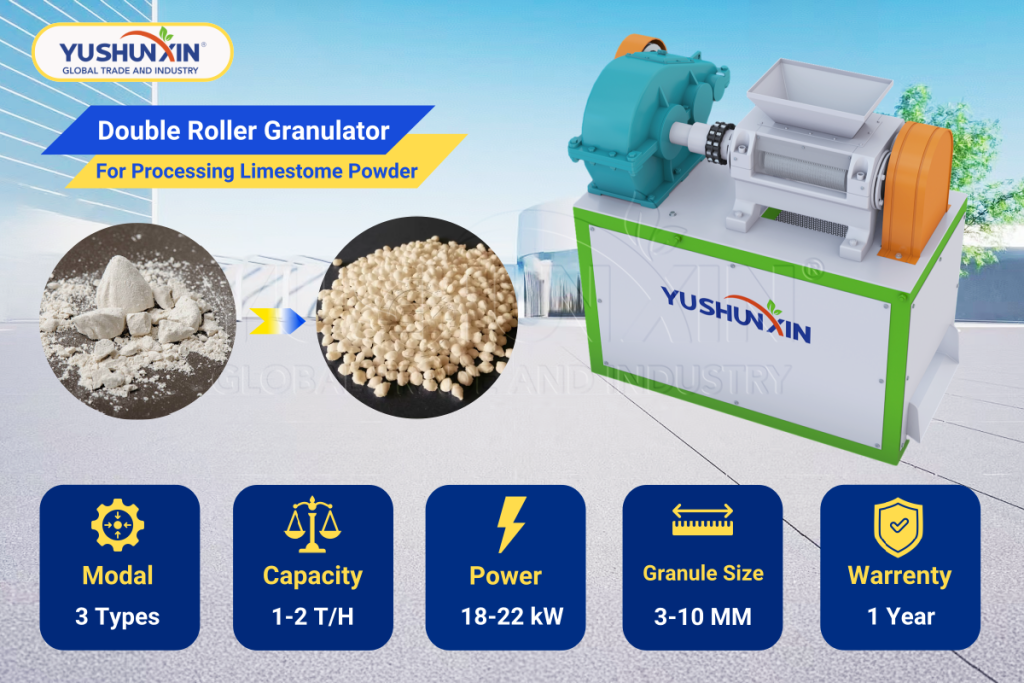
How Does Dry Granulation Technology Transform the Lime Fertilizer Manufacturing Procedure?
Dry granulation, particularly through double roller extrusion, has revolutionized the lime fertilizer manufacturing process by eliminating the need for moisture addition. This method employs robust machinery such as double roller granulators, which compact fine lime rock or powder under high pressure to form dense, uniform particles without using binders or liquid additives. Compared to wet pelletizing or ball making procedures, dry granulation offers several critical advantages.
Manufacturers benefit from reduced energy consumption, as the absence of a drying phase eliminates the need for thermal processing equipment. The procedure also prevents unwanted chemical reactions, such as premature hydration of quicklime, which can diminish product effectiveness. Furthermore, dry granulated pellets remain structurally stable during storage and transport, minimizing dust generation and product loss. By adopting extruder-based compacting equipment, companies achieve continuous, high-throughput pellet production while maintaining strict control over granule size and shape.
What Key Machines Enable Efficient Lime Powder Granule Production?
The successful implementation of dry granulation for lime fertilizer relies on a highly coordinated sequence of specialized equipment. The production line typically begins with a loader type feeder, which ensures consistent delivery of lime rock or powder to the process. A crain crusher then reduces particle size, optimizing the raw material for granulating efficiency. Next, a horizontal mixer facilitates even blending of ingredients, critical for producing homogeneous fertilizer particles.
The heart of the system is the double roller extrusion granulator, where lime powder undergoes compacting and pelletizing under precise pressure. Finished granules pass through a rotary screening machine for particle size classification, ensuring only the desired pellet size advances to packaging. Automated packaging scales and belt conveyors streamline the final handling and logistics. This integrated machinery setup not only boosts production capacity but also minimizes manual labor and enhances overall process reliability.
Why Should Industries Consistently Choose Dry Granulation for Lime Fertilizer Pellet Manufacturing?
The advantages of dry granulation extend beyond simple operational convenience. By using extrusion and compaction instead of wet granulating techniques, manufacturers avoid issues related to material stickiness, moisture sensitivity, and agglomeration. This makes the process exceptionally suitable for lime-based fertilizer, where maintaining chemical integrity and minimizing environmental impact are top priorities. Additionally, dry granulation equipment allows for quick recipe changes and rapid production line adjustments, catering to evolving market demands.
Cost efficiency, consistent granule quality, and environmental compliance represent some of the most compelling reasons for industries to invest in modern dry granulation lines. Applications range from agricultural soil conditioners to industrial water treatment pellets, illustrating the versatility of this technology across markets.
In Summary
Dry granulation, especially through the double roller extrusion process, has become the preferred method in lime fertilizer production due to its operational efficiency, process flexibility, and ability to maintain raw material integrity. From limestone powder to quicklime, the integration of advanced granulators, pelletizers, and supporting machinery enables industries to produce high-quality pellets tailored to diverse applications. For organizations seeking professional guidance and reliable equipment solutions, a seasoned manufacturer such as Yushunxin can provide end-to-end support, driving success in every aspect of lime fertilizer granule manufacturing. You can visit: https://www.extruder-granulator.com/product/limestone-powder-granulation-machine/