

In mineral fertilizer manufacturing, efficiency and product quality are paramount. Manufacturers aim to streamline processes while ensuring the final product meets strict quality standards. One technology that significantly contributes to this goal is the disc granulator. This type of granulating machine plays a crucial role in the production of NPK fertilizers, offering superior granule formation and processing efficiency. In this blog, we will explore the types of raw materials suitable for NPK fertilizer production, the role of disc granulators in optimizing the granulation process, and how other essential equipment enhances overall manufacturing efficiency.
What Are the Key Raw Materials for Mineral Fertilizer Production?
Mineral-based fertilizers rely on a variety of raw materials, each contributing to the final product's nutrient profile. The main minerals include rock phosphate, limestone, potash, dolomite, and gypsum. Each material offers unique benefits and requires specific processing methods for optimal granulation.
For example, rock phosphate is essential in the production of phosphate fertilizers and is commonly processed in rock phosphate fertilizer production. After crushing with equipment like jaw rock crushers or raymond mills, rock phosphate is granulated into uniform particles. Limestone, often used in limestone fertilizer production solutions, helps neutralize acidic soils and enhances plant growth. It is efficiently granulated in disc granulators to ensure even particle distribution, which is crucial for proper nutrient release.
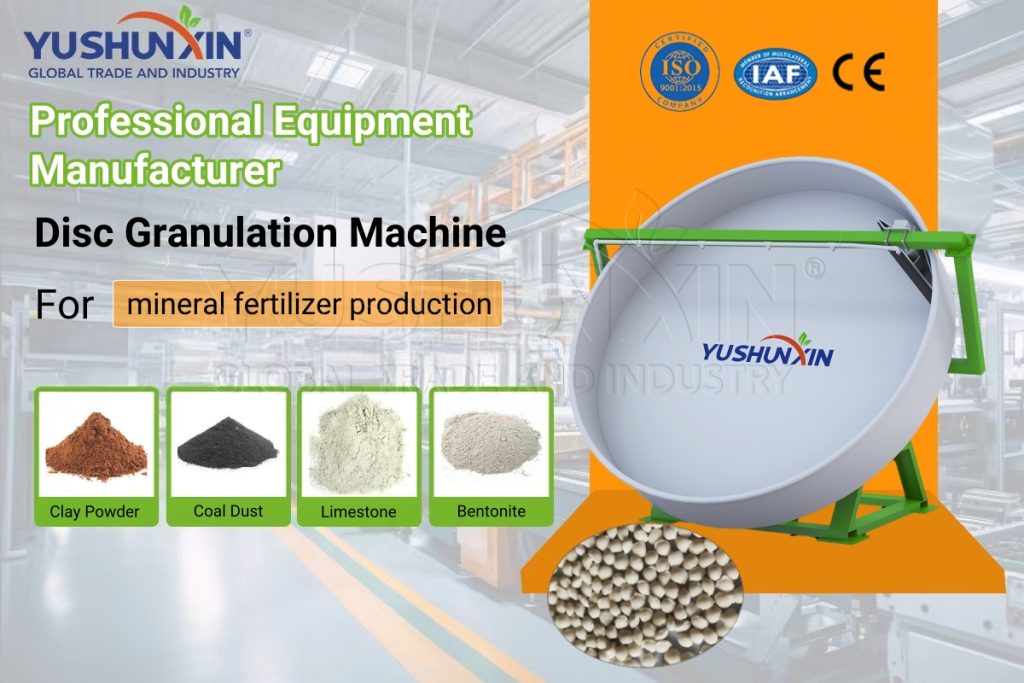
Additionally, potash ore is vital in NPK fertilizer production for its potassium content. Potash granules formed through pan granulation machines offer excellent moisture control and particle strength. Dolomite is another important material in mineral fertilizer production, often requiring fine crushing and granulation for effective use. Each raw material’s granulation needs differ, but using the appropriate granulating machine ensures the desired quality of granules.
How Do Disc Granulators Improve the Granulation Process?
Disc granulators are instrumental in improving the efficiency of the NPK fertilizer manufacturing process. This equipment forms pellets or granules by rotating a pan at an adjustable angle, allowing raw materials to be transformed into uniform particles.
The key advantage of using a pan granulator lies in its ability to adjust the speed and inclination of the disc, allowing manufacturers to control the granulation process precisely. This feature is particularly valuable when working with materials such as phosphate rock or potash ore, which require careful moisture regulation to form strong, durable granules. Disc granulators ensure that the particles grow consistently, improving the uniformity and strength of the final product.
Moreover, disc granulators have a higher efficiency compared to other granulating machines, such as drum granulators, because they use less energy while achieving high sphericity rates. This reduced energy consumption leads to lower operational costs, making them an ideal choice for large-scale production. Additionally, the simplicity of the pan granulator design ensures that the granulation process remains smooth and uninterrupted, further improving efficiency.
Which Other Machines Support Mineral Fertilizer Manufacturing?
In mineral fertilizer production, several supporting machines work in tandem with granulators to enhance the overall process. For instance, crushing machines like ore fertilizer crusher machines and jaw rock crushers are essential in reducing raw materials to the appropriate size before granulation. These machines break down hard minerals such as rock phosphate and limestone into finer particles, which are then fed into granulators for further processing.
After granulation, screening machines are employed to separate over-sized and under-sized particles from the finished granules. This ensures that only high-quality pellets are processed further, while smaller or larger particles are either recycled back into the process or discarded. The screening step is crucial for maintaining the consistency and quality of the final product.
In some fertilizer production lines, like mineral organic fertilizer production lines, additional equipment such as mixing machines may be used to blend different raw materials before granulation. These machines ensure an even distribution of nutrients, which is critical for producing high-quality NPK fertilizers.
Conclusion
The efficiency of NPK fertilizer manufacturing heavily depends on the choice of raw materials, granulation equipment, and supporting machinery. By incorporating disc granulators into the production line, manufacturers can significantly enhance their production capacity and granule quality. The ability of pan granulators to control particle size, moisture content, and granule strength makes them an invaluable asset for mineral fertilizer producers.
For those looking to optimize their production systems, investing in the right equipment is essential. As a professional fertilizer equipment manufacturer, Yushunxin offers comprehensive solutions tailored to mineral fertilizer granulation needs, helping customers achieve high efficiency and superior product quality. You can visit: https://www.mineralfertilizerproductionsolutions.com/product/disc-granulator-machine/