

When factories compare freeze dryers, the purchase price usually gets the most attention. But the machine that costs less up front can cost far more over ten years of production. Operating costs — energy, maintenance, labour, and downtime — accumulate with every batch. Understanding total cost of ownership (TCO) is what separates a good investment from an expensive mistake. This guide explains what drives freeze dryer operating costs and how to keep them under control.
Energy Is the Biggest Operating Cost
Freeze drying is energy-intensive because it runs three systems at once: refrigeration to freeze the product and keep the condenser cold, vacuum pumps to hold low pressure, and heating to drive sublimation. The largest share usually comes from refrigeration and vacuum, especially on long cycles. A well-designed industrial freeze dryer uses efficient compressors, good insulation, and a properly sized condenser so the system does not have to work harder than necessary. Poor insulation or an undersized condenser shows up directly on the electricity bill.
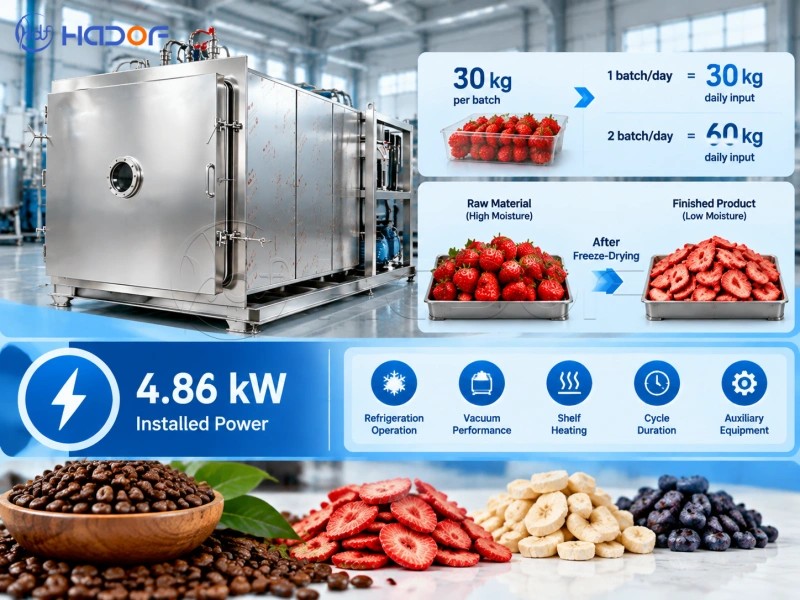
Calculate Daily Output and Energy Consumption
Batch Time and Throughput
Energy cost per kilogram depends on both the power draw and the length of the cycle. A dryer that runs a 30-hour cycle for the same product as a competitor's 24-hour cycle will use more energy per batch, even if the instantaneous power is similar. Cycle time is influenced by freezing speed, shelf temperature control, vacuum performance, and how evenly the trays are loaded. Improving any of these can reduce cost per kilogram without changing the machine.
Maintenance Costs
Maintenance is the second major cost. Vacuum pumps need oil changes and seal replacement, refrigeration systems need refrigerant checks and filter cleaning, and door seals and sensors need regular inspection. Ignoring maintenance does not save money — it usually leads to a failed batch, emergency repairs, and downtime. A simple preventive schedule, based on the manufacturer's recommendations, keeps costs predictable and extends the life of the equipment.
Labour, Utilities and Packaging
Labour cost depends on how much the line is automated. A manual line needs operators for loading, unloading, and packing, while an automated line reduces headcount but requires skilled technicians. Utilities beyond electricity — water for cleaning, compressed air, and cooling water — also add to the total. Packaging is often overlooked, but barrier films and nitrogen flushing are recurring costs that should be included in the calculation.
Calculating Total Cost of Ownership
TCO combines the purchase price, installation, energy, maintenance, labour, packaging, and downtime over the life of the machine. A simple way to compare options is to estimate cost per kilogram of finished product: total annual operating cost divided by annual output. This makes it easy to compare a cheaper machine with a higher-capacity or more efficient one. It also shows how much freeze dryer capacity matters — an oversized dryer running at low load has a poor cost per kilogram.
How to Reduce Operating Costs
There are several practical ways to lower costs. Size the dryer to your real output so it runs at a healthy load. Keep the condenser and vacuum system clean and well maintained. Load trays evenly to shorten cycles. Use recipes that match the product instead of running conservative cycles "just in case". Insulate the chamber and piping, and check door seals regularly. Finally, schedule batches so the dryer runs continuously rather than in short, inefficient bursts.
Downtime and Production Planning
Downtime is an operating cost that is easy to miss because it does not appear on an energy bill. Every hour a dryer is down is an hour of lost output, and if the product is perishable, it may also mean wasted raw material. Planning batches so the dryer runs continuously, keeping spare parts for common wear items, and training operators to handle routine issues all reduce unplanned stops. For factories running multiple products, a simple production schedule that groups similar products and cycle lengths can significantly improve utilization.
How to Estimate Your Own Operating Cost
A useful first estimate is to list the main inputs: power draw during each stage, batch duration, annual batches, maintenance budget, labour, and packaging. Multiply power by hours and your local electricity rate to get energy cost per batch, then divide by finished kilograms to get cost per kilogram. Add maintenance and labour on an annual basis, divided by annual output. This rough model is enough to compare two dryer options or two recipes, and it usually reveals which cost category deserves the most attention.
Common Mistakes
The most common mistake is comparing only purchase prices and ignoring energy and maintenance. The second is buying a dryer that is too large for the available supply, so it runs at low load. The third is skipping preventive maintenance until something fails. The fourth is using a generic recipe that is longer than necessary. Each of these quietly raises the cost per kilogram over time.
Conclusion
Freeze dryer operating costs are driven mainly by energy, maintenance, and how efficiently the machine is used. A well-sized, well-maintained production line running a matched recipe will always beat a cheaper machine that wastes power and time. HADOF Food Processing Manufacture designs freeze dryers and production lines with efficiency in mind and supports customers with sizing, commissioning, and maintenance guidance. Tell us your product and target output, and we will help you evaluate the total cost of ownership.