

The use of pomace in fertilizer production lines grows increasingly important as industries search for efficient methods of converting high-moisture organic waste into stable, marketable products. Pomace from fruits, vegetables, and crops contains beneficial nutrients, but its high water content creates technical challenges. Effective system design ensures that moisture reduction proceeds in a controlled way, allowing a smooth transition from raw material to compost, granules, and high-quality organic fertilizer.
Why Do Fertilizer Production Lines Require Special Drying Systems for Pomace?
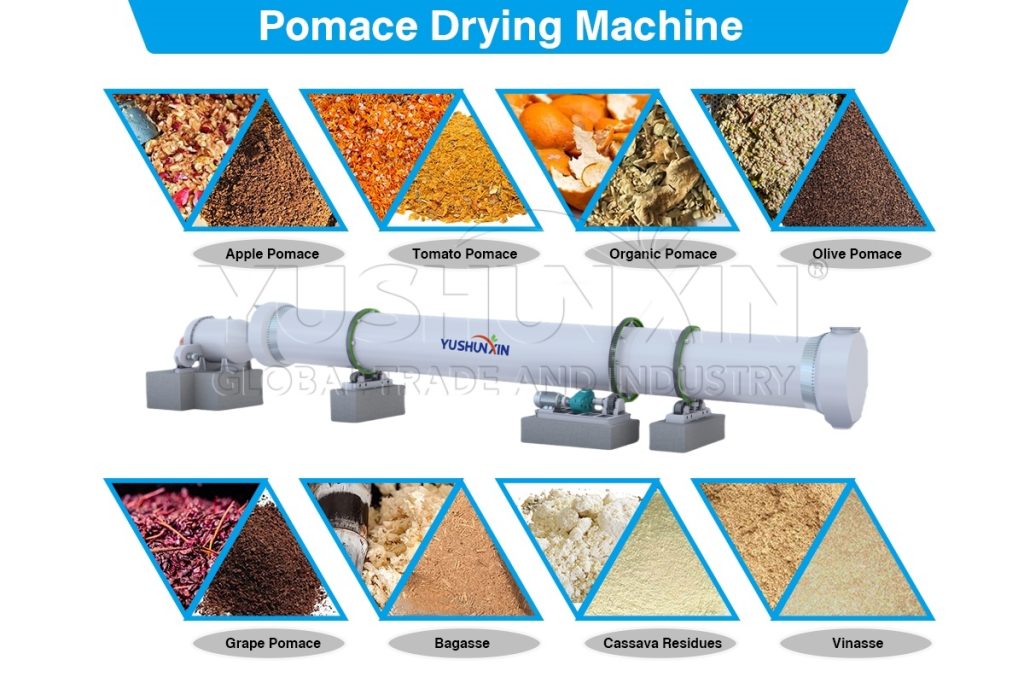
High moisture organic waste, such as apple pomace, grape pomace, tomato pulp, or crop residues, typically contains more than 80–90% water. If this material enters fertilizer production without treatment, it causes handling difficulties, slows composting speed, and reduces storage stability. Food processing enterprises, winery operations, and agricultural by-product processors all rely on effective pomace drying techniques to transform waste into valuable fertilizer.
Every industry deals with different characteristics of pomace. Fruit juice factories often manage soft and sticky fruit pomace, while wineries handle grape skins and seeds with fibrous texture. Vegetable processors face tomato pomace rich in soluble sugars. All of these examples require targeted drying solutions. When industries implement optimized system designs, they achieve reduced transportation costs, improved composting efficiency, and reliable granulation performance for fertilizer production lines.
How Does Each Stage of Moisture Reduction Support Fertilizer Production?
Moisture reduction in pomace fertilizer production follows several stages to achieve stability and prepare for granule or pellet making. In the initial stage, a dewatering machine removes free water and reduces the moisture content from around 90% to about 60–70%. This step eases the transport burden and prepares material for further processing.
In the second stage, composting equipment supports microbial decomposition. The remaining water decreases through natural biochemical reactions, while the pomace becomes stabilized organic compost. At this point, moisture content usually falls to 40–50%.
In the third stage, wet granulating machines, such as a disc granulator or rotary pelletizer, shape the semi-dry compost into uniform particles. This procedure requires controlled humidity to ensure proper granulation strength.
Finally, a pomace dryer completes the water reduction process. Specialized drying machinery lowers moisture to less than 10%, creating durable fertilizer granules that can be packaged, stored, and transported efficiently. The sequence of dewatering, compost, granulation, and drying demonstrates how system design connects each step into one productive line.
What Features Make Pomace Dryers Essential in Fertilizer System Design?
Among all machines in fertilizer production lines, the pomace dryer plays the decisive role in finalizing product quality. A well-designed dryer provides stable moisture control, uniform heating, and continuous operation. By selecting proper airflow systems and energy-efficient technology, operators prevent nutrient loss and avoid uneven drying.
Integrated drying equipment accommodates different materials, including grape pomace, apple pomace, and mixed organic residues. Adjustable temperature design allows users to optimize the process according to compost maturity and granule size. When combined with granulating machines, the dryer ensures strong particle hardness and long shelf life.
Pomace drying equipment also improves the environmental performance of production lines. The system reduces odor emissions, lowers microbial activity, and prevents clumping during storage. As a result, fertilizer producers achieve high-value granules and pellets that meet diverse market requirements.
Conclusion
In fertilizer production, pomace drying defines whether organic waste becomes a stable, profitable product or remains a disposal challenge. Industries handling fruit pomace, vegetable residue, or crop waste benefit from a complete moisture reduction procedure, from dewatering machines to compost systems, granulators, and finally a specialized pomace dryer. When each stage connects smoothly, fertilizer production lines deliver consistent granules with high nutrient value.
A professional drying equipment manufacturer—Yushunxin—provides advanced pomace dryers and related machines to support efficient water reduction and reliable fertilizer production. By applying optimized system designs, enterprises secure both economic benefits and sustainable resource utilization. You can visit: https://www.fertilizerdryer.com/pomace-drying-machine/