

In the modern fertilizer manufacturing industry, managing high-moisture organic waste poses a significant challenge. Many production lines rely on raw materials with naturally high water content, such as fruit pomace—grape pomace, apple pomace, and citrus pomace—as well as other residues like vegetable pulp and spent grains. Each type of pomace offers different nutrient profiles and physical properties, and therefore requires tailored moisture reduction processes. For agribusinesses, beverage factories, juice processors, and wineries, pomace not only represents a waste stream but also an opportunity for organic fertilizer production, composting, granulation, and further value-added processing. Using pomace as a base for fertilizer granules or pellets helps improve soil quality while promoting environmental sustainability.
What Are the Key Requirements for Pomace-Based Fertilizer Production?
When using pomace and similar organic residues as raw materials, producers need to control moisture levels throughout several process stages. At the beginning, pomace may contain over 90% water, making it unsuitable for direct composting or granulation. Therefore, fertilizer manufacturers must integrate a reliable dewatering or dehydration system. The initial stage often involves a mechanical dewatering machine, which reduces the water content to about 60-70%. For instance, a screw press dewatering equipment can efficiently handle large volumes of high-moisture pomace, separating excess liquid before the next production stage. Effective water reduction not only ensures better compost quality but also improves the efficiency and cost-effectiveness of subsequent processes like granulate or pellet making.
How Does the Pomace Dryer Improve Moisture Reduction Efficiency?
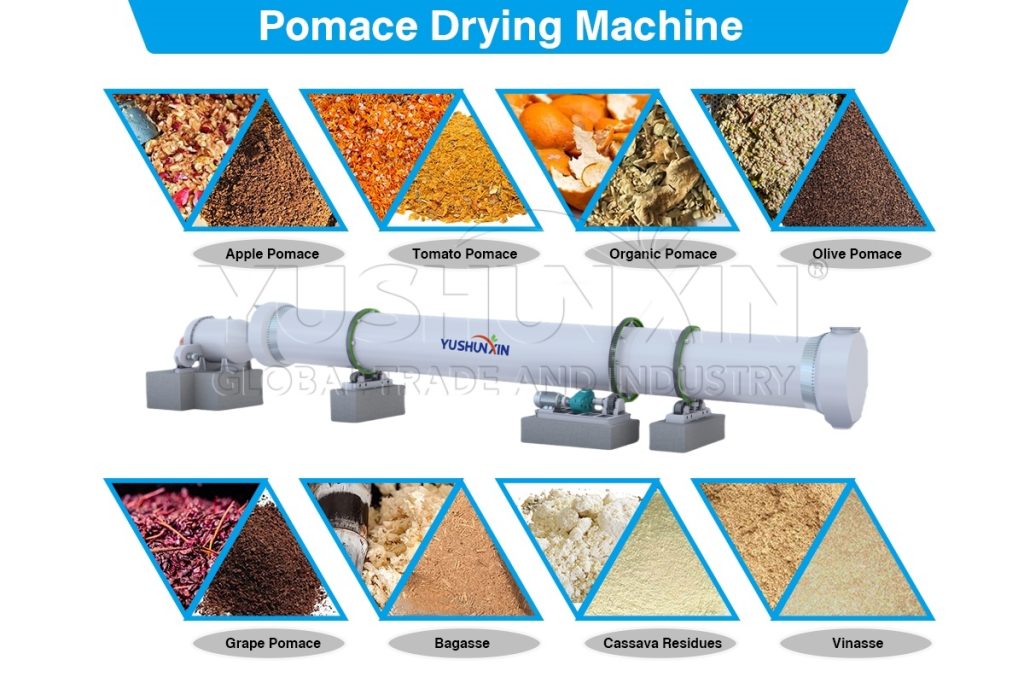
The core of a cost-effective pomace fertilizer production process lies in the pomace dryer. This specialized drying equipment plays a vital role in reducing moisture content from around 70% to below 20%—or as low as 10%, depending on the final fertilizer product specification. A pomace dryer utilizes controlled airflow, heat exchange technology, and automatic temperature regulation to achieve uniform drying without nutrient loss. The design of the pomace dryer enables continuous water reduction, ensuring steady feed for composting or direct granulation. Compared to traditional sun drying or natural evaporation, the mechanical drying machinery drastically shortens the process time and lowers the risk of spoilage. As a result, fertilizer manufacturers can maintain consistent product quality and meet regulatory standards for organic fertilizer granule or pellet production.
What Other Equipment Supports Pomace Fertilizer Production Process?
While the pomace dryer is central to the moisture reduction step, other machines also play supporting roles. After initial dehydration via mechanical dewatering equipment, the dried pomace can be moved to a composting machine for aerobic fermentation. This composting process stabilizes the organic matter and further reduces residual water, preparing the material for granulation. For producers targeting granular or pelletized fertilizers, a wet granulator or pelletizer is essential. This machinery forms uniform fertilizer granules by mixing the composted pomace with additional ingredients and shaping them into particles suitable for packaging or application. Across these stages, each machine—from the dewatering press to the compost turner and granulation system—contributes to optimized water management and efficient pomace fertilizer manufacturing.
Which Moisture Reduction System Offers the Best Value for Fertilizer Manufacturers?
For companies processing large volumes of fruit or vegetable pomace into organic fertilizer granules or pellets, investing in integrated moisture reduction technology delivers measurable benefits. Automated pomace dryer equipment, paired with dewatering and granulating machinery, enables continuous production, reduces labor costs, and ensures precise control over final moisture content. This not only improves the economic value of the fertilizer particles but also enhances storage stability and spreading performance in the field. Choosing the right drying and granulating technology depends on factors such as pomace type, required throughput, and desired fertilizer product form.
Conclusion
In conclusion, the pomace dryer forms the cornerstone of an efficient and cost-effective pomace fertilizer production line, enabling consistent moisture reduction for composting, granulation, and final pellet making. When combined with dewatering machines, composters, and granulators, manufacturers can transform high-moisture pomace into high-value organic fertilizer products. For expert guidance and advanced production machinery—such as professional pomace dryer equipment—fertilizer manufacturers can consult a trusted industry partner like Yushunxin to design customized and scalable solutions. You can visit: https://www.fertilizerdryer.com/pomace-drying-machine/